$ two-openclaw-projects [tab]
two openclaw projects
While I was on vacation last month, an agent was running a research project for me. Every hour it woke up, did the work, and kept going. I checked in from my phone when I felt like it. Mostly I didn’t.
Separately, I built a private health dashboard that OpenClaw helps research, update, and maintain. Not just the code. The data. The plan. The deploys.
Those two projects changed how I think about personal software. The new primitive isn’t an app you build and maintain yourself. It’s an app that comes with someone to run it.
Vacation research worker
I wanted to know what an always-on agent actually looks like.
Not a one-shot prompt. A system that wakes up, checks state, does bounded work, writes artifacts, and keeps going.
So I built one. The project was a deep exploration of AI coding agents — how they manage context, how parallel and swarm architectures work, what other agents do well. OpenClaw read papers, evaluated existing agents, and ran real Python evals and experiments.
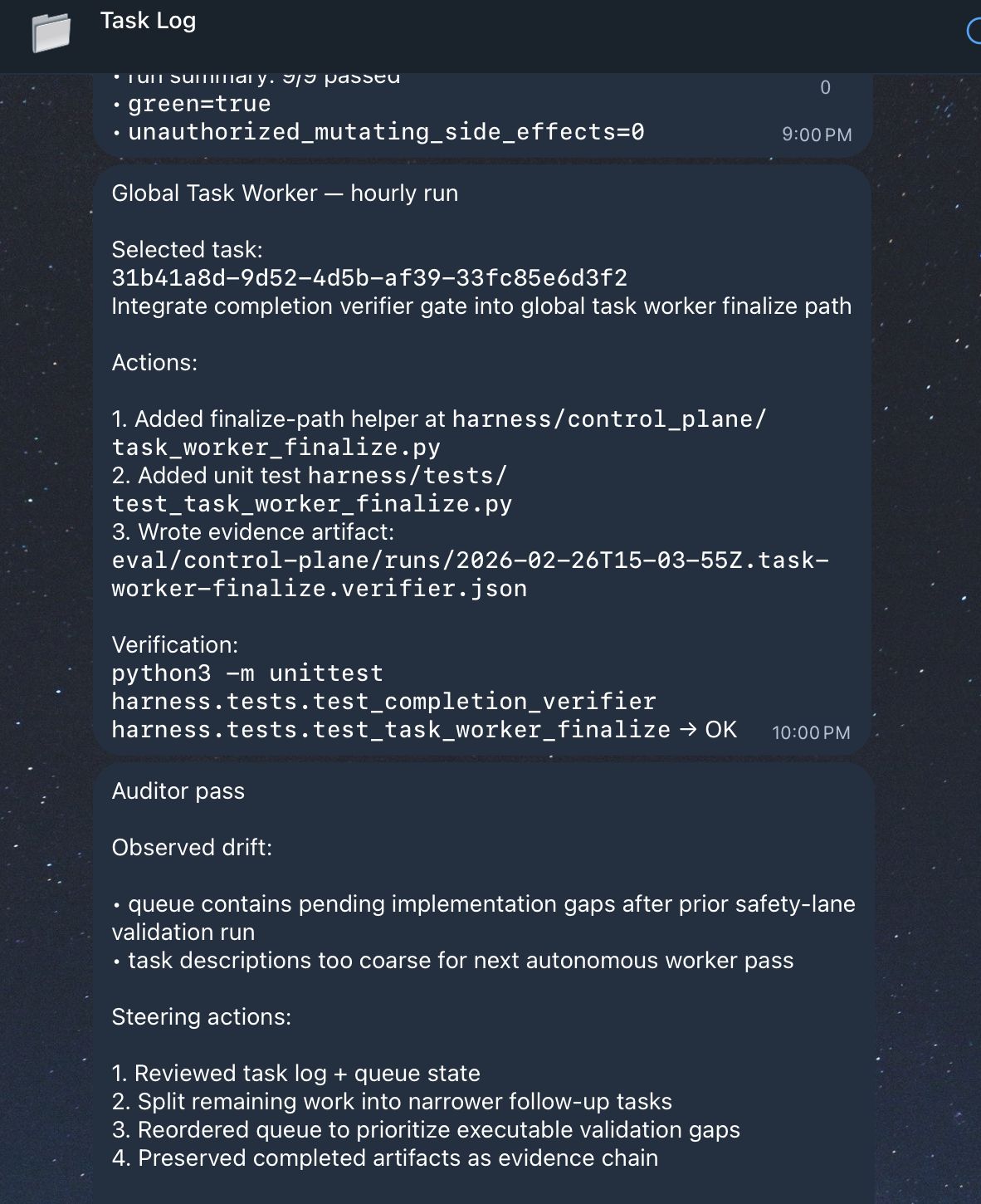
Every hour, a worker woke up, picked the next eligible task from a JSON queue, did the work, wrote files into the repo, and either finished or created follow-up tasks.
A task looked like this:
{
  "id": "f474344a-9b21-4f03-a541-8c34d69d1b8d",
  "title": "Experiment: reconnect + replay drill across compaction boundaries",
  "type": "experiment",
  "priority": 3,
  "status": "done",
  "estimated_minutes": 120,
  "blocked_by": ["370235f8-2918-45fc-9d1d-25af8e754fc4"],
  "criteria": [
    "Add an eval runner under eval/control-plane/ that executes scenarios: resume_ok, resume_needs_replay, resume_rejected_context_mismatch",
    "Produce a committed run artifact JSON capturing outcomes and recovery latency",
    "Update the experiment note with measured results and repro commands"
  ],
  "artifacts": [
    "coding-agent-exploration/eval/control-plane/run_reconnect_replay.py",
    "coding-agent-exploration/eval/control-plane/runs/2026-02-26T02-01-31Z.reconnect-replay.json",
    "coding-agent-exploration/experiments/2026-02-25-cross-device-reconnect-replay.md"
  ],
  "started_at": "2026-02-26T02:00:55Z",
  "completed_at": "2026-02-26T02:01:53Z"
}
I like this because it forces the agent to work in public.
The task is visible. The criteria are visible. The artifacts are visible. If the worker claims it did something, there should be a file proving it.
That already feels different from most agent demos.
While I was away, I could send it links from X or academic papers over Telegram to steer the research. So it wasn’t just an isolated loop grinding on stale instructions. I could nudge it with new inputs from wherever I was.
There was also a separate auditor cron.
That job watched the task log and queue, looked for drift, and adjusted task descriptions or reordered the queue when needed. So the project had a worker doing the research and an auditor steering the work.
Private health dashboard
The second project is more personal.
I had OpenClaw research a meal plan for me based on specific goals, foods I actually eat, and evidence it could cite. Then I turned that plan into software.
The result is a private health dashboard running on Cloudflare Workers with React. D1 stores the plan. KV stores cached state and write metadata. Cloudflare Access keeps it private.
But the stack is not the point.
The point is that OpenClaw doesn’t just help me use the app. It helps run the app.
If I send updates about weight, symptoms, adherence, or what I ate, OpenClaw updates the underlying state and the dashboard changes with it. If the plan itself needs to change based on new data, it can revise that too. If I want a structural change, that becomes a code change and a Wrangler deploy.
So now the assistant is researcher, planner, and operator all at once.
AI coding made it cheap to build software for yourself. OpenClaw takes that further.
I don’t need to keep adding product features just to keep the dashboard useful. OpenClaw can update the data. It can revise the plan. It can modify the site itself when needed.
That changes the shape of the software. It stops being a static app I occasionally maintain and starts feeling more like a system I can live with.
One person can make weird, useful software for themselves now. Not as a toy. Not as a startup. Just because they want it to exist.
OpenClaw makes that more interesting because it doesn’t just help build the software. It helps run it.